The E8 Body: Movement, Breath, and the Geometry of Life
The body is a 24-dimensional space.
Count: shoulders, elbows, hands. Hips, knees, feet. Head and tail. Each major joint complex contributes U(1) × SO(3) × SO(3) × U(1) — a rotation around the axis, two orthogonal rotational freedoms in 3-space, and another axial rotation. That’s 1 + 3 + 3 + 1 = 8 dimensions per complex, times three complexes. Twenty-four.
Twenty-four is the dimension of the Leech lattice, the unique even unimodular lattice in 24 dimensions, the one that gives rise to the Monster group. Is the body a Leech lattice, a maximally symmetric packing of movement possibilities?
Integration and the Number of Life
But a living body is not just articulated — it’s integrated. When you collapse one of the SO(3) factors (coordinate the joints, reduce the degrees of freedom through whole-body connection), you get 18 dimensions.
Eighteen. Chai. חי. The Hebrew number of Life. 3 copies of SO(3) × U(1), a 3-dimensional maximal torus, an abelian variety. The three-body problem. The minimum number of orbits required for chaos, complexity.
And what do you gain when you lose those six degrees of freedom? An extra U(1) — a cycle, a rhythm. The heartbeat. The metronome that makes the articulated skeleton into a living system.
The Six Lines of Energy
How many ways can the four limbs connect? Left hand to right hand. Left hand to left foot. Left foot to right foot. Right foot to right hand. And the two diagonals: left hand to right foot, right hand to left foot. That’s 4 choose 2 = 6 lines.
The spine sits at the center, the hub where all six lines cross.
Six lines, each carrying the full U(1) × SO(3) × SO(3) × U(1) structure. Each line has 8 fundamental modes of movement — the rotational directions, the phase relationships between left and right. These modes can be in phase or antiphase. They’re coupled by the breath.
The Breath and the Elliptic Curve
The fundamental movements aren’t arbitrary — they’re organized by breath:
- Forward arching (breath out) — Backward arching (breath in)
- Twisting — breath out at the extremes, in at the middle
But what about side-to-side? Side bending has breath (exhale into the bend). Side translation doesn’t. Neither does vertical translation (squats).
These breathless movements are degenerations of the elliptic curve.
Think of forward/back arching combined with side-to-side arching: together they trace circles, an elliptic curve in the configuration space of the torso. The two real cycles of this elliptic curve share the breath through complex conjugation on the Riemann surface. But pure side translation? The elliptic curve has degenerated — collapsed to a nodal or cuspidal singularity. The breath cycle vanishes.
From 48 to 240: The E8 Emerges?
Eight fundamental modes on each of six lines gives 48. But the hands and feet aren’t points — they’re five-fingered, five-toed articulations. Subdivide: 48 × 5 = 240.
240 is the number of roots in E8, the largest exceptional Lie group.
Is the body’s movement vocabulary the E8 root system? 8 free directions, 232 dimensions with relations? SO(3) rotation + U(1) rotation gives the double cover SU(2) → SO(3) — the waiter spinning a plate 720 degrees without spilling.
Chi Flow: Movement Through Play
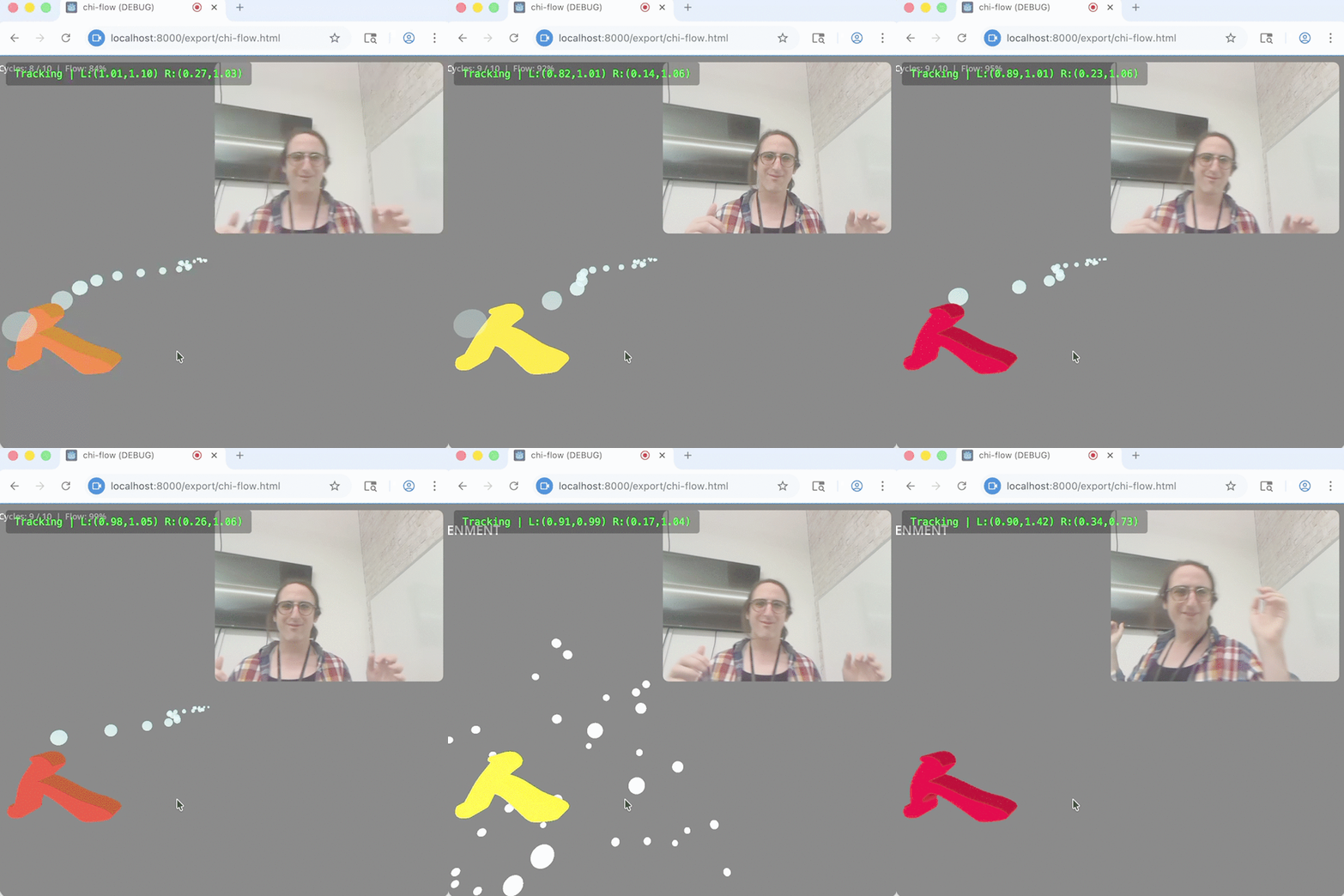
I’m building a game to explore these movements. Not by explaining the mathematics — by having people move.
The game starts simple: just 人 (rén, person), legs and head. Side-to-side translation. The degenerate case, no breath, the simplest entry point. Then side bending (breath returns). Then head circles and hip circles in antiphase. Then we add arms — 大 (dà, big) — and the twists become visible.
If the conjecture holds, level by level, the player’s body would learn the 240 fundamental movements. They wouldn’t need to know they’re exploring E8. Their nervous system would know.